Canvas UGC
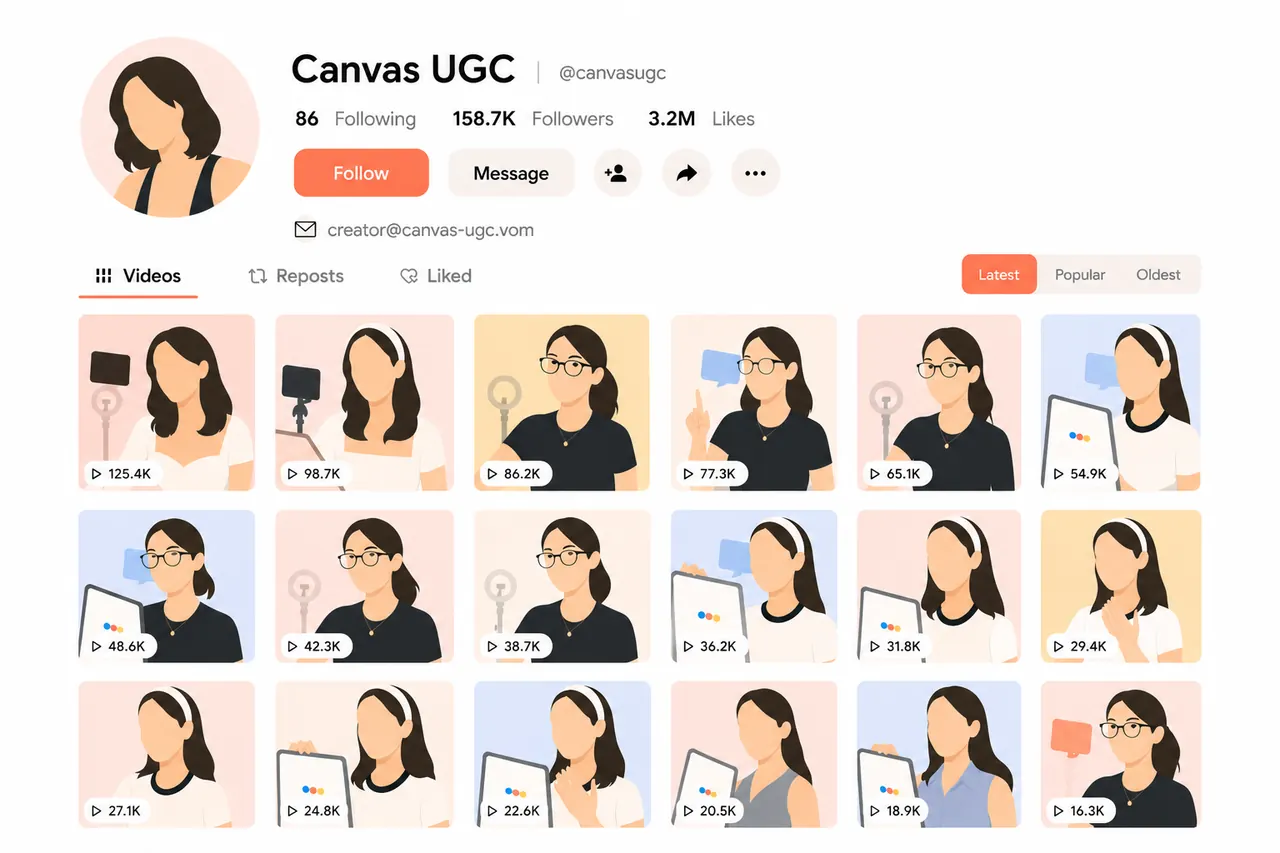
Canvas UGC — also called Tech UGC, High-Volume UGC, or ambassador-account UGC — is short-form video published on fresh, brand-dedicated ambassador accounts that look and feel like authentic consumer profiles, where creators get paid per view.
An open reference on what it is, where it came from, and how it works — for both creators and brands.
“Canvas UGC is short-form content posted on fresh ambassador accounts that creators set up to feel like authentic consumer profiles — not the brand's official page — where creators are paid for views, installs, or other results rather than for delivering a file.”
Start Canvas UGC as creator
Apply to Canvas UGC campaigns run by some of the fastest growing brands.
Run Canvas UGC as a brand
Launch ambassador accounts at scale, track every view, and pay creators for performance.
Based on high-volume UGC campaign operations, creator marketplace data, and observed short-form performance patterns across TikTok, Reels, Shorts, and Facebook Reels.
creators.viral.app helps creators find Canvas UGC campaigns. viral.app helps brands brief, track, attribute, and pay creators.
Overview
- Creators set up fresh ambassador accounts dedicated to one brand — designed to feel like real consumer profiles.
- Pay is tied to views or installs — not deliverables.
- Volume is high: tens to hundreds of videos per brand each month.
Canvas UGC inverts the creator economy. Traditional creators build a personal audience and sell either ad revenue or sponsored posts.
In Canvas UGC, the creator's personal audience doesn't matter. They spin up a fresh, brand-dedicated ambassador account — the "canvas" — that looks and feels like an authentic consumer profile, and get paid for the performance of videos posted on it.
The model grew up inside consumer apps, SaaS, and AI products that need a constant feed of short-form video. Hence the other names: Tech UGC (who buys it) and High-Volume UGC (how much gets made).
- Posted on: fresh ambassador accounts the creator sets up and runs.
- Paid: per 1,000 views (CPM) or per install (CPA).
- Volume: tens to hundreds of videos / brand / month.
- Where: TikTok, Reels, Shorts, Facebook Reels.
What is Canvas UGC?
- A creator sets up a fresh, brand-dedicated ambassador account that looks like a real consumer profile.
- They film, post, and grow it themselves — and get paid for performance, not delivery.
Canvas UGC (sometimes written ugc canvas) is a content production model where an external creator sets up a fresh ambassador account dedicated to one brand — designed to look and feel like an authentic consumer account, not a corporate brand page — and then scripts, films, edits, and publishes short-form video on it. Pay is tied to performance, not deliverables.
Canvas UGC meaning, with a quick example
A creator sets up @studywith.ana, an authentic-feeling study account dedicated to one study app. They film a 20-second tip video, post it on the ambassador account, the post earns 200,000 views, and the creator is paid that brand's CPM (e.g. $4 / 1,000 views) for those views. That's one Canvas UGC post.
Synonyms in common use
- Tech UGC — used primarily by SaaS, consumer app, and AI brands to describe the same model.
- High-Volume UGC — emphasises the production cadence (dozens of videos per month per creator).
- Ambassador-account UGC or account farming — older, informal terms used inside operator communities for the same fresh-account approach.
What it is not
- Not influencer marketing — the creator's existing audience is not part of the deal; each ambassador account starts at zero.
- Not posting on the brand's official corporate account — the ambassador account is a separate, authentic-feeling consumer profile run by the creator.
- Not traditional UGC ads — the brand is not licensing footage to run as paid media; the creator publishes organically on the ambassador account.
- Not affiliate marketing — payouts are tied to view volume or install volume on the ambassador account, not commission on referred sales from the creator's personal audience.
History & context
- Took shape between 2023–2025.
- Started in mobile apps and study tools (Quizlet, Jenni AI, Studyflash, Coconote).
- Now the dominant organic playbook for tech brands.
Three forces converged: short-form video dominance, rising paid acquisition costs, and the discovery power of fresh, niche-native accounts.
Operators stopped paying creators to post on their own profiles — and started paying them to spin up and run fresh ambassador accounts dedicated to one brand, designed to feel like real consumer profiles rather than corporate channels.
The pattern was formalised in the mobile app and study-tool space, where brands like Quizlet, Jenni AI, Studyflash and Coconote scaled to hundreds of millions of monthly views through networks of paid ambassador accounts. "Tech UGC" came from operators; "Canvas UGC" came from independent newsletters and is now the most common term among new creators.
How it works
- Creators apply, set up a fresh ambassador account, post, get paid by views.
- Brands recruit, track, attribute, pay automatically.
- The hard part isn't creative — it's tracking and payouts.
For the creator
- Apply to a brand's open canvas campaign.
- Receive a brief, brand assets, and product credentials.
- Set up a fresh ambassador account that looks and feels like an authentic consumer profile.
- Produce and publish short-form video on that account.
- Each post is tracked; the creator is paid based on the views or installs it generates.
For the brand
- Define the canvas brief — identity, niche, platforms, and content guardrails.
- Recruit creators who will each spin up and run their own ambassador account.
- Track every video posted across every account and every platform; attribute views to the right creator.
- Pay creators automatically against an agreed CPM or CPA.
The bottleneck is rarely creative. One brand × 30 ambassador accounts × 4 platforms = thousands of posts per quarter. Spreadsheets break — which is why teams running this at scale use dedicated software.
Canvas UGC for creators: how to start
- No followers required.
- Skills that matter: hooks, editing, consistency.
- A phone is enough gear.
Canvas UGC lowered the barrier to earning from short-form video. No audience needed — only scripting, filming, and editing.
New creators commonly earn a few hundred to a few thousand dollars / month in their first 90 days. Experienced ones stack multiple ambassador accounts and scale further.
Skills that matter
- Writing strong hooks (the first 1–2 seconds of a video).
- Editing in a native short-form style (CapCut, in-app TikTok / Reels editors).
- Understanding the conventions of each platform — Reels is not Shorts is not TikTok.
- Producing consistently — most paid ambassador accounts expect 10–30 videos per month.
How to start Canvas UGC, step by step
- Pick 1–2 niches you can film natively (apps, AI, study, fitness, finance).
- Recreate 5–10 viral short-form videos in that niche to build a small portfolio.
- Do your Canvas UGC sign up on a platform like creators.viral.app.
- Apply to open brand campaigns and set up your dedicated ambassador account.
- Ship 10–30 videos per month and get paid per view.
Where to find Canvas UGC jobs
Canvas UGC jobs live as open brand campaigns on Canvas UGC platforms, in operator Discords, and through direct outreach to brands already running paid ambassador-account networks on TikTok and Reels. The fastest path is a marketplace that already has brands posting campaigns.
What a Canvas UGC creator does day to day
- Scripts a hook (the first 1–2 seconds).
- Films on a phone in natural light.
- Edits a 15–45s short-form video in CapCut.
- Posts on the ambassador account's TikTok / Reels / Shorts.
- Repeats — most active Canvas UGC creators ship 1–3 posts per day.
Equipment
A modern smartphone, decent natural light, and a free editing app. Most top performers film entirely on their phone.
Canvas UGC sign up · creators.viral.app— apply to open Canvas UGC campaignsFor brands & agencies
- Now a primary organic channel for apps, SaaS, AI, fintech.
- Native short-form at favourable cost-per-view.
- Stalls without solid attribution + automated payouts.
For consumer apps, SaaS, AI products, and increasingly fintech and e-commerce, Canvas UGC is now a primary organic acquisition channel.
The appeal: a continuous stream of native, platform-fluent short-form video at a cost-per-view that beats most paid media — with no creative approval bottleneck.
What teams need to operate it
- A creator network — sourced directly or through a marketplace.
- A creator network — each creator runs their own brand-dedicated ambassador account.
- A clear identity brief so every ambassador account feels native and authentic, not corporate.
- Cross-platform tracking that resolves which creator's account posted which video.
- Automated payouts against an agreed CPM or CPA model.
The last two are where most in-house attempts stall. Without reliable attribution and automated payouts, running 20+ creators in parallel quickly becomes unmanageable.
Choosing a Canvas UGC platform
A Canvas UGC platform should resolve four things end to end: discovery of Canvas UGC creators, support for spinning up and maintaining authentic ambassador accounts, cross-platform tracking of every video, and automated payouts. viral.app is built around exactly this loop.
viral.app — Canvas UGC platform— tracking, attribution and payouts for Canvas UGC programsEconomics
- Most pay is per 1,000 views (CPM) or per install (CPA).
- Typical CPM in 2025–2026: ~$2–$8.
- Rates depend on category, platform, and track record.
Pay is almost always CPM (per 1,000 views) or CPA (per install / conversion). Typical CPM in 2025–2026: $2–$8 per 1,000 views, with variability driven by brand category, platform, and historical performance.
Comparison: Canvas UGC vs traditional UGC
| Canvas UGC | Traditional UGC | |
|---|---|---|
| Audience needed | None | Yes |
| Pay model | Per view / per result | Flat fee per video |
| Volume | 10–50+ per month | 1–4 per month |
| Posted on | Fresh ambassador account | Creator's personal account or paid ads |
| Best fit | Apps, SaaS, AI, fintech | Lifestyle, beauty, fashion |
The real edge: repeatable format libraries
- High-volume UGC isn't random daily creativity.
- Winning teams build libraries of hooks, formats, and angles.
- Creators remix; brands measure which formats actually convert.
The teams that win at Canvas UGC don't rely on inspiration. They maintain living libraries of hooks, formats, product angles, comment prompts, and editing structures — and creators remix these into dozens of variants per week.
Each variant is tracked back to its parent format, so the brand can see which hook families drive views, which angles drive installs or signups, and which editing patterns retain attention past the 3-second mark.
- Hook library — opening 1–2 second patterns proven to stop the scroll.
- Format library — repeatable structures (POV, screen-record demo, before/after, listicle).
- Angle library — product use-cases mapped to audience pain points.
- Comment-prompt library — calls that drive replies, saves, and shares.
- Edit pattern library — pacing, captions, b-roll choices, sound usage.
Views are not the only metric
- Views matter, but they're a starting point.
- Saves, comments, and conversions tell the real story.
- Track winning hook rate to learn what's actually working.
A Canvas UGC program optimised purely for views will produce viral content that doesn't move the business. Mature operators track a small portfolio of signals at the same time.
| Metric | Why it matters | Common mistake |
|---|---|---|
| Views | Top-of-funnel reach | Optimising only for virality |
| Saves / shares | Resonance | Ignoring whether people want to reuse or share it |
| Comments | Message-market feedback | Treating comments as vanity |
| Installs / signups | Business outcome | No attribution |
| Creator output | Volume engine | No quality thresholds |
| Winning hook rate | Format learning | Changing too many variables at once |
Account setup and warmup
- Ambassador accounts perform when they have a clear niche and authentic identity.
- Warmup means behaving like the target audience.
- Vary hooks more than formats; expand only after signal.
A Canvas UGC ambassador account works best when it has a clear niche, an authentic-feeling profile identity, and a repeatable content promise. An account with no theme — or one that obviously reads as a corporate brand page — rarely gets pushed by the algorithm, regardless of how many videos are posted.
Warmup
Warmup means behaving like the target audience from the account: searching the relevant topics, watching full videos in the niche, saving and commenting on adjacent posts, and following relevant niche accounts. The goal is to give the platform clean signals about what the account is about.
Operating principles
- Start with one narrow format family.
- Vary hooks more than formats — change one variable at a time.
- Use comments, retention, and conversion signals as early feedback.
- Expand into more accounts or creator angles only after you see signal.
Why brands run multiple accounts
- Multi-account distribution tests identities, faces, niches, and geos.
- Only works with real native content and high account quality.
- Tracking and attribution become non-negotiable at this scale.
Once a brand has product–content fit on one ambassador account, the next lever is multi-account distribution: running several fresh ambassador accounts in parallel to test identity angles, creator faces, niches, geo and language variants, and entirely different format families — without polluting the signal of any one account.
Important caution: this only works with real native content and proper account quality. Spammy duplication of the same video across many low-quality accounts gets suppressed and damages the brand. Multi-account distribution is a strategy, not a loophole.
At this scale — 5–20+ accounts, dozens of creators, four platforms — manual tracking falls apart. This is where dedicated tracking, attribution, and payout software stops being optional.
How viral.app fits
Once a Canvas UGC program has 10+ creators across TikTok, Instagram Reels, YouTube Shorts, and Facebook Reels, the hard part becomes tracking every post, attributing performance, managing account access, and paying creators correctly. viral.app is built for that operating layer.
viral.app — tracking, attribution, payouts— for brands running 10+ creators across multiple platformscreators.viral.app — find Canvas UGC campaigns— for creators applying to open brand campaignsBenchmarks
- Directional ranges, not guarantees.
- Vary by brand, niche, geography, and campaign quality.
| Typical CPM | $2–$8 per 1,000 views |
| Typical output | Tens to hundreds of videos / month per brand |
| Common platforms | TikTok, Instagram Reels, YouTube Shorts, Facebook Reels |
| Common buyers | Consumer apps, SaaS, AI tools, fintech, ecommerce |
Ranges vary by brand, niche, geography, and campaign quality.
Methodology
This guide synthesises observed high-volume UGC campaign structures, creator marketplace workflows, and public short-form growth patterns. Rates and examples are directional, not guarantees. Individual creator earnings and brand outcomes depend on niche, content quality, platform dynamics, and program operations.
Glossary
- Canvas UGC
- A model where creators set up and operate fresh ambassador accounts that look and feel like authentic consumer profiles, posting short-form video for a single brand and getting paid for performance.
- Tech UGC
- The same model, named after the buyer side: SaaS, consumer apps, and AI brands.
- High-Volume UGC
- Same model, named after the production cadence (tens to hundreds of videos per month).
- Brand canvas
- A fresh, brand-dedicated ambassador account run by a creator — designed to feel like an authentic consumer account rather than a corporate brand page.
- Ambassador account
- The social account a creator sets up to represent a brand under an authentic, consumer-style identity. The 'canvas' that videos are posted on.
- CPM
- Cost per mille — the dollar amount paid to a creator per 1,000 views.
- CPA
- Cost per acquisition — payment tied to a downstream event such as an app install or signup.
- Hook
- The first 1–2 seconds of a short-form video; the largest single predictor of total view count.
Canvas UGC FAQ
What is Canvas UGC? (Canvas UGC, what is it?)
Canvas UGC is a creator model where the creator sets up a fresh ambassador-style social account dedicated to a brand — designed to look and feel like an authentic consumer account, not the brand's official corporate page — and gets paid per view for the short-form videos posted on it. It's also called Tech UGC or High-Volume UGC.
Whats Canvas UGC in plain English?
You create a brand-new TikTok / Reels / Shorts account dedicated to one brand, run it as if you were a real fan of the product, post short-form videos, and get paid per 1,000 views. You don't need any followers of your own to start, and the account is yours to operate.
Canvas UGC meaning examples
Canvas UGC meaning, in plain terms: creators acting as ambassadors on fresh dedicated accounts that look like real consumer accounts. Example: a creator sets up @studywith.ana — an authentic-feeling study account — posts 20 tip videos using a study app, one earns 200,000 views, and the brand pays the creator a CPM (e.g. $4 / 1,000 views). The account never reads as a corporate channel.
Is Canvas UGC legit?
Yes. Canvas UGC is the real organic-content engine behind many top consumer apps, SaaS tools and AI products. Creators are paid by the brand (or by a Canvas UGC platform on the brand's behalf) against views verified directly on TikTok, Instagram, YouTube and Facebook.
How to start Canvas UGC as a creator (Canvas UGC how to start)
1) Pick 1–2 niches you can film natively (apps, AI, study, fitness, finance). 2) Sign up on a Canvas UGC platform like creators.viral.app. 3) Apply to open campaigns. 4) Set up a fresh ambassador account dedicated to that brand and start producing 10–30 videos per month. 5) Get paid per view. That's how to start Canvas UGC end to end.
How to get into Canvas UGC if I have no experience?
Start by recreating 5–10 viral short-form videos in your niche to build a small portfolio, then sign up on a Canvas UGC platform. Most brands accept beginners — what matters is your hooks and edit pace, not your follower count.
Where do I find Canvas UGC jobs?
Canvas UGC jobs are posted as open brand campaigns on Canvas UGC platforms (creators.viral.app), in operator Discords, and via direct outreach to brands running paid ambassador networks on TikTok and Reels.
Is there a Canvas UGC sign up I can use today?
Yes — creators.viral.app is open for Canvas UGC sign up. You create a profile, browse open brand campaigns, apply, and start running an ambassador account once approved.
What does a Canvas UGC creator actually do day to day?
A Canvas UGC creator runs one or more fresh ambassador accounts: scripts a hook, films on a phone, edits a 15–45s short-form video in CapCut, posts it on the ambassador account, then repeats. Most active Canvas UGC creators ship 1–3 videos per day across one or two accounts.
Is Canvas UGC the same as Tech UGC?
Yes. Canvas UGC, Tech UGC and High-Volume UGC describe the same model from different angles. 'Canvas' refers to the ambassador account the creator runs, 'Tech' to who buys it, 'High-Volume' to the production cadence.
Do creators need followers?
No. Each ambassador account starts at zero followers — the creator's personal audience is not part of the work. Performance comes from the For You / Reels algorithm, not from existing reach.
How are creators paid?
Most often per 1,000 views (CPM), sometimes per install or conversion (CPA). Payouts are typically processed monthly.
Which platforms are involved?
Primarily TikTok, Instagram Reels, YouTube Shorts, and Facebook Reels.
Who owns the ambassador account and the content?
Terms vary by brand. In most Canvas UGC agreements the brand retains rights to the content and to the ambassador account itself, while the creator operates it day to day. The exact ownership of the account handle is set in the agreement before posting begins.
How is Canvas UGC different from influencer marketing?
Influencer marketing buys access to a creator's existing audience on their personal profile. Canvas UGC pays the creator to build and run a fresh, authentic-feeling ambassador account for one brand — followers and reach are earned from zero, per account.